
Back to the Mags #1
Reading an old issue of The Magazine of Fantasy and Science Fiction.

Many Back Issues
I have a stack of old issues of The Magazine of Fantasy & Science Fiction ranging from 1980 to 2006. Needing a break from reading about World War II and the shitty things people in power do, I grabbed the July 2000 issue, one of the "newer" issues (ha ha), and read the first story. Then I had to read the next, and so on...
The cover is by an artist named David Hardy and is related to the first story in the issue, Mad for the Mints.
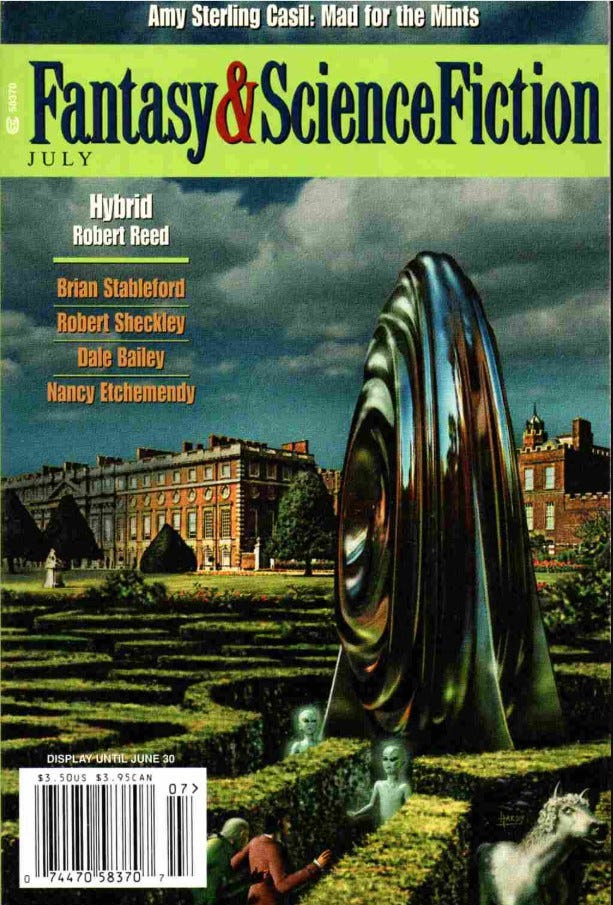
Mad for the Mints
Author: Amy Stering Casil
This story takes place in England shortly after the American Revolution has basically made King George III look ineffectual. The main character, Girard Callard, is a confectioner (i.e., he makes sweets), and has created a mint that is in incredibly high demand. Especially by King George III who, while ordering a lot of the mints, has not paid a single pound for all the mints he's been provided.
The latest batch of mints, including some set aside for another nobleman that could pay for them, has been taken by King George's men who were quite rude. In pursuit of getting paid for the batch, Girard follows the men to Hampton Court. Along the way, he runs into another one of his customers and finds out the Mad King isn't the one eating all the mints.
Something I learned: I didn't know that King George III was supposedly mad. This isn’t unusual for someone that grew up in the U.S. The centrist view of American education doesn’t take many other countries into account until it gets into the World Wars.
Thoughts: Overall it was an interesting story that was well written. Characterization wasn't a strong point of the story, but it didn't need that to be entertaining. At first, it seems like pure alternate history fantasy until near the end when it turns into science fiction.
Rating: 8/10
The New Horla
Author: Robert Sheckley
This story is about a Dartmouth-educated stockbroker that borrows a college buddy's mountain cabin. Instead of driving up there, he takes a train and makes his way to a skiing area so he can ski down to the cabin. It isn't that far on skis, but there’s a construction site between him and the cabin where he ends up hurting himself. After he makes it to the cabin, injured and bleeding, something that he's never seen before visits him. While dealing with the visitor, the protagonist has conversations with his non-present girlfriend which make him question his rationality (and this seems to be the main tie to the original story).
Original Horla: The original story The Horla was written by Guy de Maupassaunt and published in 1887. It's about a man that accidentally invites a dangerous presence into his home and questions his sanity.
Thoughts: I wasn't a huge fan of the story. It was well-written and had a good voice, describing the main character as a snobbish person; his ideas of being part of upper crust society would be damaged by admitting he'd had a supernatural encounter. Not a bad story, but not something I'd want to read again.
Rating: 5/10
Angel Face
Author: M. Rickert
The voice of this story is a tour guide leading someone around a barn that’s been turned into a museum full of Jesus-related paintings. Michael Roma is one of the artists. The museum supposedly has regular visits by the Virgin Mary which heals some people but not others with no apparent rationale. Only Mrs. Vandewhitter actually sees Mary. A young woman who doesn't see the Blessed Virgin challenges Mrs. Vandewhitter about this, and Michael notices the young woman.
Thoughts: It's the shortest story in the issue and is fairly simple. The writing style is excellent and held my interest, making me want to keep reading. I've read other M. Rickert stories and her stories are usually put together in a unique, descriptive way that’s entertaining, even if there isn’t a great deal of plot.
Rating: 7/10
The Mandrake Garden
Author: Brian Stableford
When harvested, a mandrake plant lets out a screech that instantly kills whatever pulled it from the ground. Pachytos, a young mandrake farmer, describes how dogs are used to pull the ripe mandrake plants. Under his father's condescending eye and words, he has a plant pulled for Julian, the current ruler who is away at war. They plan to send it to him to enhance his chances in battle. On the way to town, Pachytos runs into his friend Cyllo who says he has to stay out of town because word of Julian's death has reached town, and the new ruler is a Christian. The mandrake farmers are not Christians and will be a target for anyone with an axe to grind.
Thoughts: The Christians in the story are an angry mob looking to destroy the pagans and non-believers, so one theme is religious intolerance of different lines of belief. It doesn’t dive too deep into this. There isn’t a bunch of navel gazing here. The story is well-written and had me wanting to continue in the world that was built after I finished reading it.
Rating: 8/10
Seven Sisters
Author: Rick Wilber
Paul Doig is a widower, failed college professor, and failed researcher though he was a briefly successful science author. He takes his autistic son, Michael, to his dead mother's childhood home in Ireland, and they visit the Seven Sisters standing stones.
Thoughts: This story wasn't really my cup of tea. I kept waiting for something to happen, yet nothing really did. It’s more of a personal human interest story. Paul is the only person characterized through direct experience while impressions of his son, his dead wife, and her family are all from Paul’s perspective. All that said, it did have a satisfying, somewhat subtle ending.
Rating: 6/10
Dave Dickel's Historic Interview with the Father of the Hart Cart
Author: Nancy Etchemendy
The Hart Cart was designed specifically for homeless people, and the government used it to their advantage. Dave Dickel interviews Harry Hart, the Hart Cart's inventor, who is despised by the masses. Alongside him is Erica Cunning who is there to control the conversation so that the wrong anti-government messaging isn't sent out to the masses. Of course, the interview goes off the rails.
Thoughts: Because of the daily news from the U.S., this story hit hard even though I'm reading it 25 years after it was originally published. The theme is about the rich getting richer while the poor are forced to accept whatever the lousy politicians deem they should have. As with today, the rich own the politicians. The last few paragraphs of this story are something that I can imagine happening today.
Rating: 9/10
Hybrid
Author: Robert Reed
Hybrids are something between a wolf and a man, and they are a big part of the history of this world. Welks is a man whose parents left him a lot of money, yet he is exceedingly lonely. He decides to get a hybrid as a pet even though they're dangerous and require special enclosures. When he discovers one that has escaped, he starts to see them in a different light.
On Robert Reed: At first, Robert Reed was an acquired taste, but he has become one of my favorite short story authors. He’s prolific, and I don't think I've read many duds from his bibliography.
Thoughts: This story has a really interesting question-answer-story format. Each question hints at what’s coming in the following paragraphs. Sometimes it's exposition about the history of the hybrids, sometimes the question is answered through the actions by and around Welks, sometimes a bit of both. I really enjoyed the section in the story where he gave a brief overview of the history of the hybrids. I’m a sucker for briefly sketched alternate histories. The main theme is about how far a man will go to defeat the loneliness he feels. Another one is that sometimes individuals in a group may be more capable than the group norm.
Rating: 9/10
Inheritance
Author: Dale Bailey
At the story start, Nicholls's adoptive parents have been dead from a car accident for 8 years. He never knew his biological parents nor was he ever overly concerned with finding out about people that abandoned him. When a lawyer calls and tells him his biological uncle has died and left his property to Nicholls, it's just one more shock added to the fact that his wife is cheating on him. Despite people telling him not to visit the property, he goes anyway. At the house he now owns, he discovers the truth about his parentage.
Thoughts: Dale Bailey is another writer that I've read before and have liked a lot of his stories. At 32 pages, It's the longest story in the issue and worth the read. The narrator is dealing with longing to be a real artist, confirmation that his wife is unfaithful, and confusion on why an unknown blood relative left him an inheritance. A slight feeling of dread builds up over the first two-thirds then it gets real dark near the end.
Rating: 8/10
Overall Feelings on the Issue
This was a pretty good issue with a lot of author names I'd read before or recognized from other various anthologies. Even at 25 years old, nothing seemed too dated and the Nancy Etchemendy story really applies to the U.S. today. I was planning on getting rid of this issue after reading the issue, but Nancy’s story and Hybrid by Robert Reed have me thinking about keeping it.)
These stories may be hard to find since most have not been reprinted anywhere else. If you stumble across a copy in a used book shop or yard sale, I suggest getting it. The link for each story name takes you to that story’s entry in the Internet Speculative Fiction Database. Another good source for finding stories is the Free Speculative Fiction Online site which has links to stories that authors have online that are free to read. If you’re a fan of fantasy, science fiction, or just specific authors, you must bookmark these sites.